When We Listen…

What happens when we listen to another?

What becomes possible when someone listens to us?

When we listen, we offer with our attention an opportunity for wholeness.

Our listening creates a sanctuary for the homeless parts within the other person.

That which has been denied, unloved, devalued by themselves and by others.

That which is hidden.

In this culture, the soul and the heart too often go homeless.

Listening creates a holy silence.

When you listen generously to people they can hear the truth in themselves, often for the first time.

And in the silence of listening, you can know yourself in everyone.

Eventually, you may be able to hear, in everyone and beyond everyone, the unseen singing softly to itself and to you.

Rachel Naomi Remen

Could YOU use a good listening to?

Twice each month, I host a Virtual Changes gathering (by phone), that offers simply this – an opportunity to both listen and be listened to.  There’s never a fee.

You can get more information and a list of scheduled gatherings here.

I look forward to having you join us AND to listening!

The Power of Presence, Music and Listening

One night in 1945, at the end of World War II, an American soldier’s decision to play his trumpet stemmed–in part–from his ability to pause into the present moment with compassion and empathy.  By choosing to play “his love song” for the last remaining German sniper threatening his unit,  Col. Jack Leroy Tueller recognized the fear and loneliness common to us all.  As a result, the sniper was so moved that he couldn’t shoot, and surrendered the next morning.   Now 90, Tueller shares his precious story.

http://www.karmatube.org/videos.php?id=2794

Has there been a time in YOUR life when [in a moment of conflict] you’ve been able to pause and respond from a place of compassion and empathy for the other person’s experience?

Your comments are always welcome!


First Steps – to an Open Heart

first-steps - photoPicture this classic scene:  Two women sitting on the grass a couple of feet apart, facing each other.  One with her arms and hands outstretched to the 12-month-old(-ish) little boy who’s standing between the two of them.  The 2nd woman–almost like a puppeteer–provides a pair of outstretched fingers for his hands to grasp above his head to help him stay steady on his feet as he ponders taking tentative first steps toward the 1st woman.  Both woman offer a stream of encouraging and cajoling words.

That’s the scene I encountered while out on my morning walk through the neighborhood.

At that moment, I paused on the sidewalk, to offer respectful, wonder-filled, silent witness to the magical moment of “first steps” that seemed primed to occur.  As I stopped, the little boy turned toward me, with his feet still tentatively moving forward.  The women invited me into their space and shared moment by inviting him, “Oh, you want to go to her…..Go to her.”

So I turned, stepping from the sidewalk onto the grass with my own outstretched fingers as an invitation for him to consider.

And, much to all our surprise, he took a couple of determined steps forward to grab onto my fingers and stand triumpant while each of us cheered his accomplishment.

I stifled the urge to pick him up and snuggle him with grateful, loving kisses – and instead, turned him back to return him to the 1st woman.

In the meantime, I heard both women marvel at his apparent comfort in coming right to me.  As the 1st woman exclaimed, “He don’t LIKE people!” the three of us shared a knowing, between-us-women kind of chuckle.

A brief moment of wonder – concluded as quickly as it had begun.

I quietly turned to resume my walk — with a noticeably lighter step — as I began to ponder about those invisible, yet real, energetic qualities that others experience in our presence.

Something inside me seems to recognize and/or connect with something inside the other that says it’s safe (or not)–and vice versa.

Of course, it can become more complicated than that in real life.  For example, con artists take advantage of this connection to then take advantage of us.  Likewise, our own neediness can sometimes blind us to what’s unsafe in the other or the situation in which we find ourselves.

Learning to nurture an open, yet discerning heart space is one of the fundamental skills I teach in Focused Self-Care.

I’ll also be addressing this topic in my upcoming free teleclass:  Resolved to Change:  Align Head and Heart.  I’d love to have you join us!

In the meantime, I’d love to hear your comments and feedback!


We would be one

I often marvel at how often the hymn tunes we sing on Sunday mornings, or the readings or the sermon reflect so clearly and dearly on issues I’m exploring throughout the rest of my life.   [and just now, a part of me went "duh".....church would be pretty useless if it didn't relate to the rest of my life!].

Perhaps what I meant to say, was how I love being able to pause, and be reminded of how my life is living itself forward – sometimes quite unknowingly – from a place of inner rightness that only reveals tiny portions of itself at any given moment.

For example, several months ago, I shared a drawing and a poem through which I had begun to explore the concept of 

I’m not alone – and it’s not all up to me.

as a means of discovering

a me that’s separate from my work.

Then, as the new year approached, I found myself choosing two themes to carry my living forward through the next 12 months – each of which I now realize flow seamlessly from that earlier piece.

In choosing the first – “exquisite sufficiency” – I’ve borrowed a bit from Buckminster Fuller as a means of more fully experiencing that elusive quality of “enough”.  [hmmm - re-reading that sentence, I realize how oxymoronic it is - to more fully experience enough.  Ah well, the hour is late, and the year is still young!]

And, as if that 1st theme didn’t promise me enough opportunity for growth, I discovered that a 2nd theme was also choosing ME – that of “community”.   Interestingly enough, I had created a mandala drawing (see below) on January 1 – and only a week or so ago realized that in that drawing,  I had already created a visual community.

 As the year progresses, you’ll be hearing lots more about the various levels of community-building here at ASK ME House.   For example, our Virtual Changes group continues to flourish and expand in scope, I’ve recently created a “Kitchen-Table-Circle of Allies“, started hosting a new Meetup group,  am developing a formal internship program and will be incorporating an online community component to stresswell.

And, this morning, as I joined my roomful of spiritual journey companions in song, it all felt so wonderfully (and sufficiently) right!

We Would Be One [1] 

We would be one, as now we join in singing,
a song of love to pledge ourselves anew
to that high cause of greater understanding
of who we are, and what for us is true.
We would be one in searching for that meaning
which binds our hearts and guides us on our way.


[1] Words:  Samuel Anthony Wright
  Music:  Jean Sibelius  [Hymntune = Finlandia]
  © 1933, renewed 1961 Presbyterian Board of Christian Education

All Those Helpful People

In this post,  I’m delighted to share a poem from one of my Focusing colleagues, Herbert Schroeder.   I love this poem  – and find that it’s applicable to ALL “those helpful people”  – whether it’s the folks who surround me and/or the “treasure map” multiple parts inside of me.
 
To All Those Helpful People
 
To the people who thought that they could
Make me feel the way that I should,
I say: “Let me be real,
Whatever I feel;
Stop trying to make me feel good!”


On the Edge of a Journey

A time of waiting — preparing a space
for gentle unfolding of new steps forward.

Not so easily shared in words – this new way ahead -
yet somewhere on awareness’ edge
an emerging knowing awakens to my presence.

Quietly hoping you’ll serve as witness
joining together with me
to meet and greet whatever comes alive.

© 2010 Mary Elaine Kiener

Alone Together – United in Our Uniquity

As I create a space inside for listening to you,
I begin to listen to myself in a different way.

As I relax into becoming your companion listener,
I learn to trust my own unfolding journey.

As I witness and honor your gentle unfolding,
I gain compassion for my own wounded parts.

As I better understand the uniquities of your anxious, fearful “not-wantings”,
I discover how to be with those that dwell deep within me.

Alone together,
We glimpse the unity of our mutual wantings,
Together alone.

ASK ME

Early one morning in the fall of 2006, I found a computer-printed envelope addressed to ASK ME House just inside my front door.  Inside was one printed page, which included the following:

An ASK ME poem for the ASK ME House.  I came across this poem in a book and thought you might like to see it since your house shares its title.  I hope you enjoy it and/or find it meaningful.

Ask Me by William Stafford

Some time when the river is ice ask me
mistakes I have made. Ask me whether
what I have done is my life. Others
have come in their slow way into
my thought, and some have tried to help
or to hurt: ask me what difference
their strongest love or hate has made.

I will listen to what you say.
You and I can turn and look
at the silent river and wait. We know
the current is there, hidden; and there
are comings and goings from miles away
that hold the stillness exactly before us.
What the river says, that is what I say.

To:  ASK ME House (1027 Seymour)
Fr:  Anonymous (at least for now)
On this 27th of October, 2006

Several years later, I still have not learned the identity of the person who left me this precious gift–the first in a series of annual “love notes” to the house that have been arriving every October 27.   [It took me a couple of years to actually note the connection between October 27 and the house's street address of "1027".   And, it wasn't until 2009 that there was any personal reference to me by name--where previously the sender had also noted that s/he "didn't even know who lived in the house."]

Each annual packet of goodies has included some reference to “ASK ME” – and yet I remain most intrigued by how accurate a glimpse the poem offers into the overall philosophy and foundations of what “ASK ME House” is truly all about……

I am filled daily with peace through this gentle reminder of the process by which I choose to live, with gratitude for having discovered the work of William Stafford, and with awe for the enigma of how the introduction took place.

Now–if I could just solve the mystery of who “Anonymous” is….!

Walking the Talk When Our Going Gets Rough


You’ve just encountered a moment from hell.  You were going along fine, when suddenly life tripped you up.  It might have been a hurtful email from someone you thought was a friend.  Perhaps you lost a longtime customer or client to a business colleague whose motives you now question.  Or someone else questioned your own actions or motives.

Your first (and hopefully, brief) reaction to any of the above situations might be one of shock, with a pinch of anger or hurt (perhaps both!):  “How could he do that?”, “What’s wrong with her?”, or “Why me?”

Now what?

If you were to act from within this stress-filled mindset, chances are you would end up making the situation worse.  The more you stay focused on the negatives or on assigning blame, the more your actions and communication will then focus toward you becoming the winner and the other person the loser.  Then, your brief moment in hell expands to a day, or longer.

It’s easy to talk our talk.  And, it might even be easy to walk the talk when the going is smooth.  But what happens when the going gets rough?  Are there some strategies that can help us not only better understand our talk, but also make the walking easier?

Expand our awareness

When we are under duress, our perceptions often become narrowly focused on our own survival.  This is natural (our brains are actually hard-wired that way), and is especially important in matters of life and death.  However, the more we allow an adrenaline-fueled mindset to direct our thoughts and our actions, we become less aware of ourselves and less willing to explore alternative behaviors.

One way to expand our awareness is through the use of the Johari Window (1), a communication model initially developed by Joseph Luft and Harry Ingham.  Using the analogy of a quarterpane window, each pane of the window describes 1 of 4 different levels of self-awareness:

1.    Open Area:  Things I and others know about me
2.    Blind Spot:  Things I don’t know, but others do know about me
3.    Hidden Area:  Things I know, but others don’t know about me
4.    Unknown:  Things that neither I nor others know about me

In a close-minded person, the “open area” quadrant is often rather constricted, with tightly held boundaries.  Through the careful give-and-take of self-disclosure and requesting feedback , it is possible to enlarge one’s open area, which then serves to decrease the size and influence of one or more of the other three areas.  As a person gains self-knowledge and self-esteem, this process also promotes the development of transparency and trust within his relationships with co-workers, family and friends.

Choose your response

With the Choice Map (2), Dr. Marilee Goldberg Adams offers a useful option.  Instead of reacting from within our “Judger Self”, she invites us to respond from within our “Learner Self.”  This approach allows us to make thoughtful choices that are solution-focused and provide for win-win relationships.


Talk less, listen more

Within this model, questions such as “Whose fault is it?” or “How can I prove I’m right?” shift to questions such as “What do I want?”, “What can I learn?” and “What’s the best thing to do?”  As a person’s reactive, inflexible and judgmental mindset becomes more thoughtful, flexible and accepting, her mood transitions from pessimism, stress and limitations to optimism, hope and possibilities.  Over time, relationships are able to grow and flourish within an atmosphere of respect and trust.

Becoming the change

Gandhi is well known for his admonition:  “Be the change you want to see in the world.”  I have adopted it as a cornerstone for both my business’  philosophy and how I choose to live my life.

Every day seems to gift me another unanticipated challenge to learn how to walk my talk–which is certainly easier said than done.

It helps if I can see each challenge as a well-timed opportunity rather than as a distressing burden.  It also helps to know that this is a learned skill, especially given our physiological tendency to self-protect when under stress.

Through the use of learning-oriented questions to increase both my levels of self-awareness and understanding of others, I can practice acting in harmony with my deepest values and beliefs.

**************************************

Footnotes:

  1. For an interactive Johari Window exercise, go to: http://kevan.org/johari.cgi
  2. Adapted from Goldberg, M. (1998).   The Art of the Question. Hoboken, NJ: John Wiley & Sons.

[printable-PDF-version]

You may freely share and/or reprint in other electronic or print publications, provided you include the following attribution:

ASK ME House article © 2008 Mary Elaine Kiener, RN, PhD, all rights reserved. Reprinted with permission. Does your body manage stress well? Find out at:  http://stresswell.com/saliva-ph-test/

Please also send me a courtesy note with a copy of the publication.

Conversations with My GPS

Start Your Engine

Day 1 of a 14-day car trip by myself:  A beautiful day, filled with clear skies, warm sun and an open road.  It was a perfect day for a drive through the countryside.

I had a destination to reach the following day.  But, for a day, I was totally on my own—free to explore a bit of the lovely countryside that patiently waited.

Alone with my thoughts, I was suddenly tempted by the promise of a scenic by-way.  As I chose the new road, my peaceful reverie was suddenly intercepted by a woman’s voice, quietly announcing:  “Calculating route.”

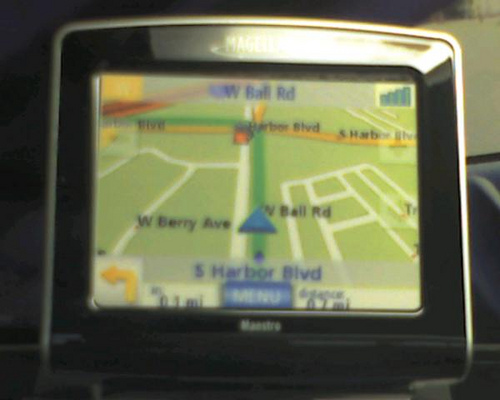
Ah, yes, I’d almost forgotten about my new travel companion—my recently purchased GPS (Global Positioning System).  Inspired by her brand name (Magellan) and feminine voice, it had seemed only natural to name her “Maggie.”

“Such a pleasant change,” I thought, as I recalled car trips with my late husband, during times when I was driving.  Whenever I would choose to stray from a route that he had expected me to take, he would often respond with a startled and impatient “Why did you turn there?” or “Where are you going now?”  Followed by either raised voices or stony silence, with an unhealthy dose of blame or shame and hurt feelings thrown in for good measure.

As the days of my journey with Maggie unfolded, I found that—just as she helped me navigate a 2000 mile car trip—she emerged as a kind of metaphor for my inner wisdom as I navigate my personal life journey.  With a growing sense of curiosity, I explored various ways I might listen to myself that were nestled within my experience with Maggie as a travel companion.

A still, small voice

Once Maggie knew our destination, she became like the still, small voice of wisdom inside of each of us—our inner compass.  As I neared a turn or an exit, she would always give me gentle spoken reminders, ending with a little chime as I would arrive at the designated exit.  Often, especially when on the freeway, she would even let me know that I should “stay on the current road.”

Reminder to self: How often do I check in with myself—my inner wisdom?  Do I remember to listen to my “felt sense”—that bodily sense of knowing that I can always trust to keep me on my right path?  How often do I ignore that little voice inside of me?  How often do I wait until it has to practically shout at me before I stop and pay attention?

Maintaining focus

As Maggie started to work, her opening screen would include a reminder to keep my eyes on the road and pay attention to my driving.  Brief check-ins with the screen images were ok, but my focus needed to be in the task at hand:  driving safely from here to there.

Reminder to self: In my daily life, where is my focus?  Am I paying attention to the present moment, or am I lost in thoughts and feelings from past events?  Am I so bogged down with could’s, should’s and ought’s that I miss the beauty and perfection that surrounds me?  When I’m feeling stressed and overwhelmed–not sure of where to turn–do I stop at least long enough to breathe?  Do I remember to check in with myself and get my bearings before barreling ahead?

The inner critic

Once I had programmed the desired destination, Maggie offered several alternative settings (i.e., fastest time, shortest distance, most use of freeways or least use of freeways) before creating the recommended route.  Whenever I happened to deviate from the route she had provided, Maggie always maintained her equanimity, with never an emotional outburst replacing her ever-present, even-tempered response, “Calculating route.”

Reminder to self: That inner critic that often resides inside my brain, is NOT part of my inner wisdom.  I can acknowledge the fear that tends to underlie my mind’s self-protective settings that manifest as blame, shame, snarky and snotty.  And then switch to my preferred channel of self-talk.

A long leash of serendipity

A few times, I evidently chose one too many scenic detours from the established route.   However, Maggie declined to pout or offer any snide comments.  Instead, in a sort of resigned puzzlement, she quietly invited me to “Say a command,” as her screen offered several options for me to clarify my needs.  Once she was reassured of my final destination, she was content to let me continue to explore various byways.  Blessedly, she also kept track of my time commitment, so that I could easily arrive at my destination on time.

Reminder to self: The more I can honor my creative urges, while respecting necessary deadlines, the less stressful my life will become.  Knowing my inherent level of curiosity and my propensity for immersing myself within an exploratory journey of learning, how can I consistently anticipate and include that exploration time into my scheduling process?

Tuning out the world

On several occasions during the trip, I knew exactly where I was and how to get to where I was going.  I was self-assured and confident, my direction was clear.  At times, I simply ignored the quiet commands as they occurred (especially easy if the radio or a CD was playing).  Once or twice, I actually turned Maggie off, with gratitude for both her willingness to assist, but also for the renewed silence in the car.

Reminder to self: Sometimes the chatter from the outside world distracts me from my values and goals.  Am I able to separate myself from the distractions that surround me?  Am I able to make a well-reasoned decision and move forward toward desired action steps with confidence and without need for outside support and acclamation?  And am I willing to bless myself with occasional silence?  Do I schedule opportunities to withdraw from the busy push-tug world around me (e.g., by turning off email and cell-phone)?

A personal GPS unit

For all her recognized benefits, Maggie could never quite measure up to being my ideal travel companion and conversationalist.  She’s a bit too matter-of-fact, with no ability for idle chit-chat.  And she seems to have no sense of humor.  While I loved her non-judgmental approach, I did miss the opportunity for compassionate and empathetic dialogue.

Interestingly, during the middle of my two week journey, I participated in a Focusing Institute Summer School.  During 6 full days, along with about 70 other wonder-full souls, I learned to listen to my “felt sense,” which Ann Weiser Cornell  describes as “a body sensation that has meaning.”

As a result, I returned from my travels with a second fully-functioning personal GPS system.  In this case, GPS could mean “grounded power source,”  “gut-perfect sensations,” or even “grounded presence, subtlely.”  This newly tuned device resides deep within my body wisdom, ever ready to compassionately keep me on track.  As long as I’m willing and ready to listen.

*******************

You may freely share and/or reprint in other electronic or print publications, provided you include the following attribution:

ASK ME House article © 2008 Mary Elaine Kiener, RN, PhD, all rights reserved. Reprinted with permission. Does your body manage stress well? Find out at:  http://stresswell.com/saliva-ph-test/

Please also send me a courtesy note with a copy of the publication.