First Steps – to an Open Heart

first-steps - photoPicture this classic scene:  Two women sitting on the grass a couple of feet apart, facing each other.  One with her arms and hands outstretched to the 12-month-old(-ish) little boy who’s standing between the two of them.  The 2nd woman–almost like a puppeteer–provides a pair of outstretched fingers for his hands to grasp above his head to help him stay steady on his feet as he ponders taking tentative first steps toward the 1st woman.  Both woman offer a stream of encouraging and cajoling words.

That’s the scene I encountered while out on my morning walk through the neighborhood.

At that moment, I paused on the sidewalk, to offer respectful, wonder-filled, silent witness to the magical moment of “first steps” that seemed primed to occur.  As I stopped, the little boy turned toward me, with his feet still tentatively moving forward.  The women invited me into their space and shared moment by inviting him, “Oh, you want to go to her…..Go to her.”

So I turned, stepping from the sidewalk onto the grass with my own outstretched fingers as an invitation for him to consider.

And, much to all our surprise, he took a couple of determined steps forward to grab onto my fingers and stand triumpant while each of us cheered his accomplishment.

I stifled the urge to pick him up and snuggle him with grateful, loving kisses – and instead, turned him back to return him to the 1st woman.

In the meantime, I heard both women marvel at his apparent comfort in coming right to me.  As the 1st woman exclaimed, “He don’t LIKE people!” the three of us shared a knowing, between-us-women kind of chuckle.

A brief moment of wonder – concluded as quickly as it had begun.

I quietly turned to resume my walk — with a noticeably lighter step — as I began to ponder about those invisible, yet real, energetic qualities that others experience in our presence.

Something inside me seems to recognize and/or connect with something inside the other that says it’s safe (or not)–and vice versa.

Of course, it can become more complicated than that in real life.  For example, con artists take advantage of this connection to then take advantage of us.  Likewise, our own neediness can sometimes blind us to what’s unsafe in the other or the situation in which we find ourselves.

Learning to nurture an open, yet discerning heart space is one of the fundamental skills I teach in Focused Self-Care.

I’ll also be addressing this topic in my upcoming free teleclass:  Resolved to Change:  Align Head and Heart.  I’d love to have you join us!

In the meantime, I’d love to hear your comments and feedback!


One Breath Bigger

Jennifer Louden recently addressed the idea of becoming “Skillfully Empathetic” – an especially challenging dilemma for those of us who are caregivers.    We have huge hearts, and often expect that somehow we must be able to care for everyone else in the world.

In the piece, Jen offered some really insightful perspectives related to boundary-setting, discernment and self-care–as part of her year-long experiment in “Savoring and Serving.” 

In addition, she shared a wonderful  exercise in creating “energy boundaries” from Hiroboga‘s How to Rule Your World

As I read through and experienced this luscious exercise (thanks to both of you – Jen and Hiroboga for making this available!), I was intrigued by how beautifully it might nurture the concept of “Self-In-Presence” that I teach as part of  Inner Relationship Focusing.   That is, perhaps becoming more skillful at sensing our boundaries at an energy-based level of  body-mind-spirit-oriented knowing would also help us better respond to whatever challenges life brings our way. 

For example, I often teach that we need only become “one breath larger” than our biggest fear to become “Self-in Presence.”  Now, with this lovely exercise,  once we can  become clearer about sensing, recognizing and even shifting ALL of our boundaries – whether it’s our “skin envelope”, our energy body or our energy field – it should be easier for us to become that one breath larger than our most anxious or fearful part.

I invite you to check out both Jen’s article and Hiroboga’s exercise at the end of the article.  Then, stop back here and let me know what you think, ok?

Focusing – A Pause that Refreshes our Body-Mind-Spirit

[printable pdf]

One of the things I love about Michael Licenblat is his emphasis on becoming more “resilient to pressure and expanding your capacity, instead of trying to reduce your stress.”

In his blog post, Faster than the Speed of Sound, he reminds us that–just as lightning “travels” faster than thunder in a storm–within stressful situations, our emotions often travel faster than our logic.  He goes on to offer  three wonderful suggestions that can help us to build our resilience (“bounceback”) capacity.

Over the past few years, I have also come to appreciate the ability of Inner Relationship Focusing to further enhance my own resilience capacity.  Learning to Focus has helped me to pause, notice and listen to my body-mind spirit in a whole, new way, thereby freeing the life-forward energy that often gets gridlocked by stress.

And, as I continue to nurture a Focusing-oriented approach to my own life and work, I find myself continually amazed at how this simple-yet-elegant process manages to enhance and deepen every other process within my own wellbeing toolkit.

Would you like to give it a try? 

I’ve created several Guided Focusing Exercises that will let you get a taste of the Focusing process.

I’d love to hear about your experiences.

Resolved to Change – Aligning Your Head and Your Heart

Printable PDF

How often have you found yourself saying:   “I need to change”?   It doesn’t matter whether the change involves eating right, exercising more, earning more money, etc. 

Our hearts tell us that we really want our lives to work better.  We start out—time after time, resolved to “do better” this time around. 

At first, all goes well. At least until our head joins in, apparently determined to keep us from changing.   The repertoire of critical voices inside our head often includes “My life isn’t right,” “I know I’m the problem”  and/or “I’m always standing in my own way.”

Then, the tug of war begins in earnest.  The longing of the heart battles the worried, critical voices of the head–each side bound and determined to get its own way.

Our response at this point, tends to include one (or even both) of the following:

  • We concentrate our efforts on what we DO want.  We’ll set intentions, create a dream board, recite affirmations.   But the Law of Attraction can go only so far.  Even the most carefully designed plan is still bound to meet some resistance along the way.
  • Attempting a logical response, we then try to understand the part inside that doesn’t want to change.  We attempt to reason with the critical part, or even defend against the voices that tell us we’re doomed to fail even before we start.  Unfortunately, all we get from all this effort is lots of inner judgment, blame and shame.

My mentor,  Ann Weiser Cornell likes to say,  “What we don’t realize is that the very way we are speaking about the problem is standing in the way of solving it…..That saying ‘how can I get myself to change?’ is sort of like trying to move a rug while standing on it!”

What might happen if, for a moment, we started with the source of the unease we’re feeling–the part that doesn’t want to change?   A great start would be to shift that initial statement to something like this:  “I want to change, but I don’t.”  [Or “I want (or need) to eat better, exercise more, earn more money, etc.”]  This at least recognizes that there are two sides to the issue. 

Notice, for a moment, how it feels to express it this way :  “I want to ____, but I don’t.”   Better, perhaps, yet it still sounds a bit judgmental doesn’t it?  It’s so easy for us to dip back up into our head, with its critical perspective.

Now, let’s see what might happen if we add just one little word:  “something.”  As in, “Something in me wants to change and something doesn’t.”  Ah, so there are two parts–a part that wants to and a part that doesn’t want to.   Now there’s even more space around that stuck place inside.  It’s not “just” me – it’s not who I am.    

Taking that even one step further, we might say:  “I’m sensing something in me that’s feeling frustrated and yearning for change.  It sees another part of me as the problem, and is trying to get it to change.”

Can you feel how that adds even more space?  And maybe even room for a little curiosity to bubble through–especially about that second part that doesn’t want to change.

Now we’re acknowledging that the not-wanting part might be as valid as the part that does want to change.  After all, it probably has its own very good reason for being the way that it is.  We don’t have to become best buddies with it.   However, we can at least respectfully allow it to speak, be heard and understood.  

And then–instead of seeing the not-wanting as an enemy to be eliminated–perhaps we could see it instead as a gift of life-forward energy just waiting for us to quietly and curiously unwrap it?  Could there really be a fragile space of wanting hidden beneath the critical judging thoughts and worried, anxious feelings?

In this way, we’re no longer trying to get ourselves to change.  Instead, we’re standing in a relationship of compassionate curiosity toward each of these parts. 

Here’s an exercise you can try out for yourself. 

First, complete the following sentence by filling in the blank with something in your own life you wish to change:

 Something in me wants to ________________, AND, something in me doesn’t.

Take a moment to notice how that feels inside.

Then, if you’d like to experience the next step in the process, I’ve recorded a brief (12 minutes long) guided exercise that’s available for you to download.

Once you’ve listened to the recording, notice how it feels.  Is it different than when you started the exercise?  [I welcome your feedback - either in the comments below or via email]

And, if you’re still feeling a bit “stuck,” you might want to schedule a “live” Guided Focusing Session that’s designed especially for you (and your unique journey).

Wanting and Knowing

The heart wants

what it wants.

The mind knows

what it knows.

The spirit suffers

what it suffers.

Until I

–in Presence–

gently  sit–

As compassionate witness

inviting

felt thoughts,

held longings,

and struggles to be heard.

In time,

we rise as one,

unfolding the journey forward.

*   *   *   *   *   *   *   *   *   *   *    *    *    *    *    *    *

  • Are you struggling with a situation in your life? 
  • Needing to make a decision and/or feeling stuck? 
  • Experiencing strong emotions that feel overwhelming at times? 

I invite you to learn more about Inner Relationship Focusing and how it can help you find a compassionate way forward.

Walking the Talk When Our Going Gets Rough


You’ve just encountered a moment from hell.  You were going along fine, when suddenly life tripped you up.  It might have been a hurtful email from someone you thought was a friend.  Perhaps you lost a longtime customer or client to a business colleague whose motives you now question.  Or someone else questioned your own actions or motives.

Your first (and hopefully, brief) reaction to any of the above situations might be one of shock, with a pinch of anger or hurt (perhaps both!):  “How could he do that?”, “What’s wrong with her?”, or “Why me?”

Now what?

If you were to act from within this stress-filled mindset, chances are you would end up making the situation worse.  The more you stay focused on the negatives or on assigning blame, the more your actions and communication will then focus toward you becoming the winner and the other person the loser.  Then, your brief moment in hell expands to a day, or longer.

It’s easy to talk our talk.  And, it might even be easy to walk the talk when the going is smooth.  But what happens when the going gets rough?  Are there some strategies that can help us not only better understand our talk, but also make the walking easier?

Expand our awareness

When we are under duress, our perceptions often become narrowly focused on our own survival.  This is natural (our brains are actually hard-wired that way), and is especially important in matters of life and death.  However, the more we allow an adrenaline-fueled mindset to direct our thoughts and our actions, we become less aware of ourselves and less willing to explore alternative behaviors.

One way to expand our awareness is through the use of the Johari Window (1), a communication model initially developed by Joseph Luft and Harry Ingham.  Using the analogy of a quarterpane window, each pane of the window describes 1 of 4 different levels of self-awareness:

1.    Open Area:  Things I and others know about me
2.    Blind Spot:  Things I don’t know, but others do know about me
3.    Hidden Area:  Things I know, but others don’t know about me
4.    Unknown:  Things that neither I nor others know about me

In a close-minded person, the “open area” quadrant is often rather constricted, with tightly held boundaries.  Through the careful give-and-take of self-disclosure and requesting feedback , it is possible to enlarge one’s open area, which then serves to decrease the size and influence of one or more of the other three areas.  As a person gains self-knowledge and self-esteem, this process also promotes the development of transparency and trust within his relationships with co-workers, family and friends.

Choose your response

With the Choice Map (2), Dr. Marilee Goldberg Adams offers a useful option.  Instead of reacting from within our “Judger Self”, she invites us to respond from within our “Learner Self.”  This approach allows us to make thoughtful choices that are solution-focused and provide for win-win relationships.


Talk less, listen more

Within this model, questions such as “Whose fault is it?” or “How can I prove I’m right?” shift to questions such as “What do I want?”, “What can I learn?” and “What’s the best thing to do?”  As a person’s reactive, inflexible and judgmental mindset becomes more thoughtful, flexible and accepting, her mood transitions from pessimism, stress and limitations to optimism, hope and possibilities.  Over time, relationships are able to grow and flourish within an atmosphere of respect and trust.

Becoming the change

Gandhi is well known for his admonition:  “Be the change you want to see in the world.”  I have adopted it as a cornerstone for both my business’  philosophy and how I choose to live my life.

Every day seems to gift me another unanticipated challenge to learn how to walk my talk–which is certainly easier said than done.

It helps if I can see each challenge as a well-timed opportunity rather than as a distressing burden.  It also helps to know that this is a learned skill, especially given our physiological tendency to self-protect when under stress.

Through the use of learning-oriented questions to increase both my levels of self-awareness and understanding of others, I can practice acting in harmony with my deepest values and beliefs.

**************************************

Footnotes:

  1. For an interactive Johari Window exercise, go to: http://kevan.org/johari.cgi
  2. Adapted from Goldberg, M. (1998).   The Art of the Question. Hoboken, NJ: John Wiley & Sons.

[printable-PDF-version]

You may freely share and/or reprint in other electronic or print publications, provided you include the following attribution:

ASK ME House article © 2008 Mary Elaine Kiener, RN, PhD, all rights reserved. Reprinted with permission. Does your body manage stress well? Find out at:  http://stresswell.com/saliva-ph-test/

Please also send me a courtesy note with a copy of the publication.

Conversations with My GPS

Start Your Engine

Day 1 of a 14-day car trip by myself:  A beautiful day, filled with clear skies, warm sun and an open road.  It was a perfect day for a drive through the countryside.

I had a destination to reach the following day.  But, for a day, I was totally on my own—free to explore a bit of the lovely countryside that patiently waited.

Alone with my thoughts, I was suddenly tempted by the promise of a scenic by-way.  As I chose the new road, my peaceful reverie was suddenly intercepted by a woman’s voice, quietly announcing:  “Calculating route.”
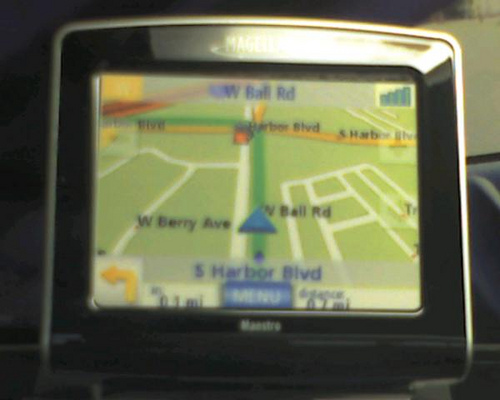
Ah, yes, I’d almost forgotten about my new travel companion—my recently purchased GPS (Global Positioning System).  Inspired by her brand name (Magellan) and feminine voice, it had seemed only natural to name her “Maggie.”

“Such a pleasant change,” I thought, as I recalled car trips with my late husband, during times when I was driving.  Whenever I would choose to stray from a route that he had expected me to take, he would often respond with a startled and impatient “Why did you turn there?” or “Where are you going now?”  Followed by either raised voices or stony silence, with an unhealthy dose of blame or shame and hurt feelings thrown in for good measure.

As the days of my journey with Maggie unfolded, I found that—just as she helped me navigate a 2000 mile car trip—she emerged as a kind of metaphor for my inner wisdom as I navigate my personal life journey.  With a growing sense of curiosity, I explored various ways I might listen to myself that were nestled within my experience with Maggie as a travel companion.

A still, small voice

Once Maggie knew our destination, she became like the still, small voice of wisdom inside of each of us—our inner compass.  As I neared a turn or an exit, she would always give me gentle spoken reminders, ending with a little chime as I would arrive at the designated exit.  Often, especially when on the freeway, she would even let me know that I should “stay on the current road.”

Reminder to self: How often do I check in with myself—my inner wisdom?  Do I remember to listen to my “felt sense”—that bodily sense of knowing that I can always trust to keep me on my right path?  How often do I ignore that little voice inside of me?  How often do I wait until it has to practically shout at me before I stop and pay attention?

Maintaining focus
As Maggie started to work, her opening screen would include a reminder to keep my eyes on the road and pay attention to my driving.  Brief check-ins with the screen images were ok, but my focus needed to be in the task at hand:  driving safely from here to there.

Reminder to self: In my daily life, where is my focus?  Am I paying attention to the present moment, or am I lost in thoughts and feelings from past events?  Am I so bogged down with could’s, should’s and ought’s that I miss the beauty and perfection that surrounds me?  When I’m feeling stressed and overwhelmed–not sure of where to turn–do I stop at least long enough to breathe?  Do I remember to check in with myself and get my bearings before barreling ahead?

The inner critic

Once I had programmed the desired destination, Maggie offered several alternative settings (i.e., fastest time, shortest distance, most use of freeways or least use of freeways) before creating the recommended route.  Whenever I happened to deviate from the route she had provided, Maggie always maintained her equanimity, with never an emotional outburst replacing her ever-present, even-tempered response, “Calculating route.”

Reminder to self: That inner critic that often resides inside my brain, is NOT part of my inner wisdom.  I can acknowledge the fear that tends to underlie my mind’s self-protective settings that manifest as blame, shame, snarky and snotty.  And then switch to my preferred channel of self-talk.
A long leash of serendipity

A few times, I evidently chose one too many scenic detours from the established route.   However, Maggie declined to pout or offer any snide comments.  Instead, in a sort of resigned puzzlement, she quietly invited me to “Say a command,” as her screen offered several options for me to clarify my needs.  Once she was reassured of my final destination, she was content to let me continue to explore various byways.  Blessedly, she also kept track of my time commitment, so that I could easily arrive at my destination on time.

Reminder to self: The more I can honor my creative urges, while respecting necessary deadlines, the less stressful my life will become.  Knowing my inherent level of curiosity and my propensity for immersing myself within an exploratory journey of learning, how can I consistently anticipate and include that exploration time into my scheduling process?

Tuning out the world

On several occasions during the trip, I knew exactly where I was and how to get to where I was going.  I was self-assured and confident, my direction was clear.  At times, I simply ignored the quiet commands as they occurred (especially easy if the radio or a CD was playing).  Once or twice, I actually turned Maggie off, with gratitude for both her willingness to assist, but also for the renewed silence in the car.

Reminder to self: Sometimes the chatter from the outside world distracts me from my values and goals.  Am I able to separate myself from the distractions that surround me?  Am I able to make a well-reasoned decision and move forward toward desired action steps with confidence and without need for outside support and acclamation?  And am I willing to bless myself with occasional silence?  Do I schedule opportunities to withdraw from the busy push-tug world around me (e.g., by turning off email and cell-phone)?

A personal GPS unit

For all her recognized benefits, Maggie could never quite measure up to being my ideal travel companion and conversationalist.  She’s a bit too matter-of-fact, with no ability for idle chit-chat.  And she seems to have no sense of humor.  While I loved her non-judgmental approach, I did miss the opportunity for compassionate and empathetic dialogue.

Interestingly, during the middle of my two week journey, I participated in a Focusing Institute Summer School.  During 6 full days, along with about 70 other wonder-full souls, I learned to listen to my “felt sense,” which Ann Weiser Cornell  describes as “a body sensation that has meaning.”

As a result, I returned from my travels with a second fully-functioning personal GPS system.  In this case, GPS could mean “grounded power source,”  “gut-perfect sensations,” or even “grounded presence, subtlely.”  This newly tuned device resides deep within my body wisdom, ever ready to compassionately keep me on track.  As long as I’m willing and ready to listen.

*******************

You may freely share and/or reprint in other electronic or print publications, provided you include the following attribution:

ASK ME House article © 2008 Mary Elaine Kiener, RN, PhD, all rights reserved. Reprinted with permission. Does your body manage stress well? Find out at:  http://stresswell.com/saliva-ph-test/

Please also send me a courtesy note with a copy of the publication.